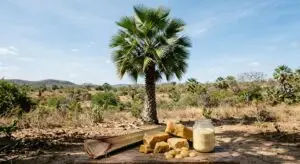



When talking about Brazilian carnauba wax, it is impossible to separate the product from the territory that originates it: the Caatinga, a Brazilian biome and one of the most biodiverse on the planet in semi-arid conditions. The carnauba palm (Copernicia prunifera) is native to this region, and its sustainable exploitation carries a dual role—economic and environmental—that few production chains manage to balance with the same naturalness.
A wax born from Brazilian biodiversity
Unlike synthetic petroleum-derived waxes, carnauba wax is of plant origin and biodegradable. It is obtained from the pruning of the palm tree leaves, a process that, when conducted responsibly, neither harms the tree nor the surrounding ecosystem; on the contrary, it encourages the preservation of native vegetation, since the carnauba tree generates economic while standing. This logic of "from Brazilian biodiversity to the customer's production line" is what underpins the responsible supply model practiced by companies like Alkinda Wax.
Social impact in the communities of the Caatinga
The carnauba chain employs thousands of families in the interior of Northeast Brazil, many of them in regions with few formal income alternatives. The harvesting of the straw, processing, and wax extraction generate labor, acting as an important source of subsistence for rural communities. Companies operating in this link of the chain have the responsibility to strengthen sustainable management practices, technical training, and the appreciation of local labor, connecting social development to the final quality of the product delivered to the industry.
Certifications as a guarantee of traceability
For responsible buyers, sustainability cannot just be talk and must be accompanied by documented traceability. Therefore, certifications such as ISO 22000, FDA, Halal, and Kosher have become decisive criteria in choosing suppliers. They guarantee that the purchased wax has a controlled origin, from the field to the container, and that the chain meets the standards required by regulated sectors, such as the pharmaceutical and food industries.
Sustainability as a competitive advantage
Companies with experience and efficient processes, such as Alkinda Wax, with two generations of operation in the sector, manage to combine sustainable production with competitive prices. This makes it possible to maintain inventory throughout the 12 months of the year, even considering the seasonality of the harvest, ensuring predictability for customers who cannot run the risk of supply shortages.
More than just a market trend, sustainability in the carnauba chain is now a prerequisite for doing business with major global industries. Brazilian suppliers that invest in environmental, social, and governance (ESG) compliance tend to pull ahead in upcoming international negotiation rounds.
Want to know in detail about Alkinda Wax's certifications and sustainability practices? Get in touch with our team and request our complete compliance documentation.